Basement Waterproofing in Warrington, PA
Warrington Township is full of well-built homes from the 1980s, ’90s, and early 2000s — the kind of solid suburban construction Bucks County is known for. But those homes are now entering a different phase of life. At 20 to 40 years old, the original waterproofing membranes, drain tile, and grading that came with the house are reaching — or have already passed — the end of their effective lifespan. If your basement has started taking on water for the first time, it’s rarely bad luck. It’s usually a builder-grade system finally wearing out — and it’s exactly why basement waterproofing in Warrington has become such a common project for homes in this age range.
Why Newer Homes in Warrington Still Need Basement Waterproofing
Exterior Coatings Wear Out
The tar or asphalt-based coatings builders typically applied to foundation walls in the ’80s, ’90s, and 2000s were only ever designed to last 10 to 15 years. Once that coating cracks or delaminates, usually as backfill soil settles and shifts around the foundation, it stops doing its job entirely.
Grading Flattens Out
Grading that sloped water away from the house at the time of construction flattens over two or three decades of settling, landscaping, and soil compaction. Downspout extensions get removed or buried. None of this happens overnight, which is exactly why it catches homeowners off guard — the failure is gradual until it isn’t.
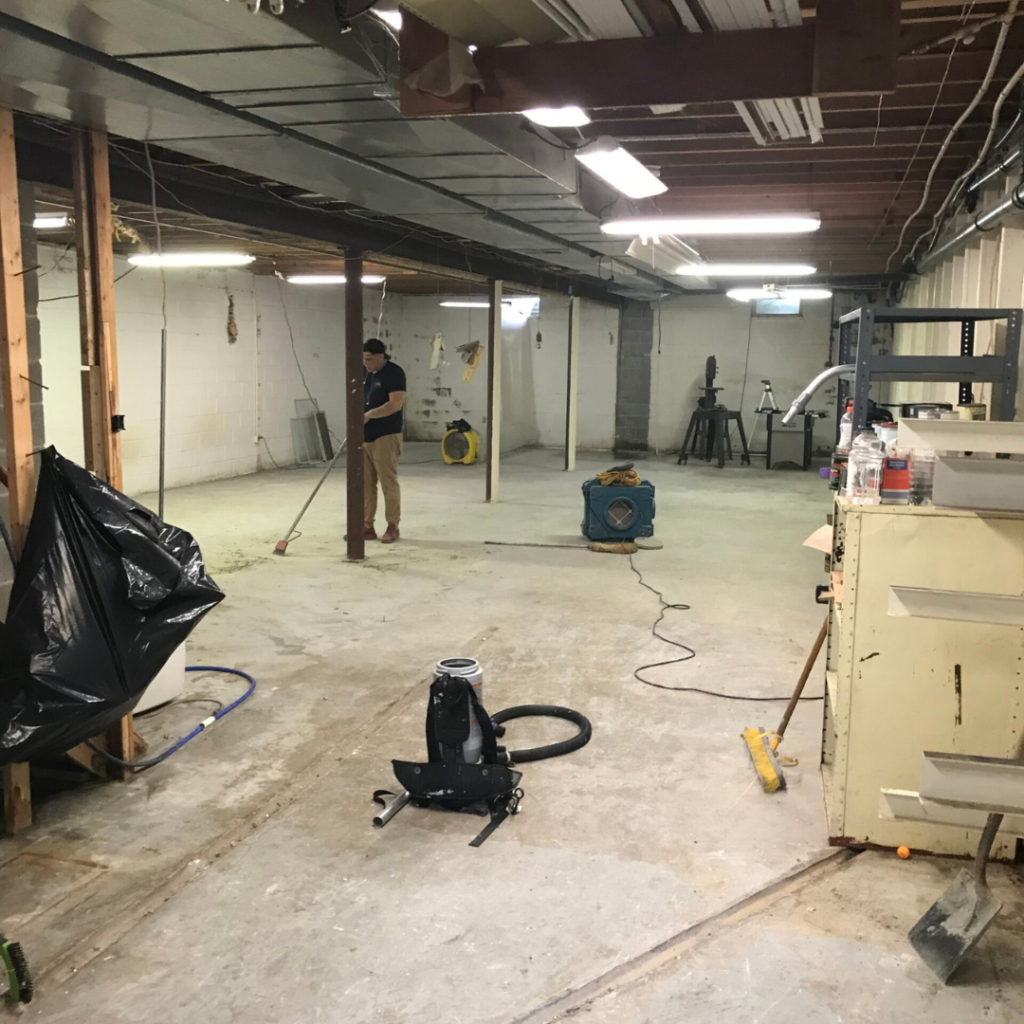
Clay Soil Adds Hydrostatic Pressure
Bucks County’s dense clay soil compounds the problem. Clay holds water and expands when saturated, building up hydrostatic pressure against foundation walls and floors. Builder-installed drain tile was sized for a house that had recently been backfilled with looser soil and intact grading — not for clay that’s had 20-plus years to compact and shift. When that original drainage system is asked to handle decades of accumulated pressure, it starts to fall behind. That’s the underlying reason so many Warrington homes see their first basement water issue right around the two-decade mark.
The Most Common Water Intrusion Problems We See in Warrington
When we inspect basements throughout Warrington, four issues come up again and again.
Water entry at the floor-wall joint
The most common entry point in the township, caused by aging drain tile. Hydrostatic pressure pushes water through the seam where wall meets slab, often visible as a thin line after heavy rain.
Hydrostatic seepage through poured concrete walls
Most Warrington homes have poured concrete foundations, which develop hairline shrinkage cracks over time. Under sustained hydrostatic pressure, even a fraction-of-an-inch crack can let water seep through steadily.
Sump pump failure
Builder-installed pits are often undersized for a mature drainage system's needs, and pumps rarely get upgraded until they fail — usually mid-storm. A pump sized for a new home often can't keep pace 20 years later.
Downspout and grading issues
Removed downspout extensions, built-up mulch beds, and settled soil all redirect water toward the foundation instead of away from it.
Interior Perimeter Drainage
Channels water that gets past the foundation walls into a discreet drain line before it can reach your floor. It's installed along the interior footing and works even when exterior grading and drain tile have already failed.
Sump Pump Upgrade With Battery Backup
Replaces undersized or aging builder pumps with a properly sized unit, plus a backup system that keeps running through power outages — exactly the conditions when basements flood most often.
Wall Vapor Barriers
Control the moisture that seeps or wicks through concrete before it reaches finished walls, framing, or storage, protecting against mold and material damage even when bulk water isn't present.
Crack Repair With Epoxy Injection
Seals hairline cracks in poured concrete walls from the inside, restoring the wall's water-tightness without excavation.
Exterior Waterproofing
Where grade and access allow, addresses the problem at the source by applying a new membrane and drainage layer directly against the foundation wall.
French Drains
Manage surface and groundwater in the yard itself, intercepting water before it ever reaches the foundation.
Why Warrington Homeowners Choose Pressman
Pressman Home Services is based right in Warminster, and we’ve been providing basement waterproofing in Warrington for more than 20 years. That local footprint matters — we know Bucks County’s clay soil, the typical foundation types used in Warrington’s 1980s-2000s subdivisions, and the specific failure patterns that come with houses of that age, because we’ve seen them house after house, street after street.
Every project starts with a free inspection, so you know exactly what’s happening before you commit to anything. Our work is backed by a satisfaction guarantee, and we offer financing options for homeowners who want to address the problem now without waiting. Water doesn’t wait for business hours, so we also provide 24/7 emergency service for active flooding or sump pump failure. If you need help today, call us at (215) 614-5444.
Our Waterproofing Process — What to Expect
- Free inspection. We assess your foundation, drainage, grading, and sump system to identify exactly where water is entering and why.
- Custom recommendation. You get a clear, written explanation of the problem and the specific systems recommended to fix it — no generic packages.
- Installation. Our crews complete the work with minimal disruption to your home and yard, using the systems best suited to your foundation type and the source of the intrusion.
- Follow-up. We check back after installation to confirm the system is performing as expected, especially after the next significant rain event.
Yard Drainage and French Drains in Warrington
Some Warrington neighborhoods sit lower than the land around them, and water collects there after every heavy rain. Drainage also varies across the township, so a home near Neshaminy Creek can face different conditions than one closer to the Route 611 corridor. When the yard itself is the problem, a French drain can intercept water before it reaches the foundation. Signs that point to a drainage problem outside include:
- Standing water or a lawn that stays marshy after rain
- Soil washing out of flower beds or along walkways
- Basement leaks that show up mainly during heavy storms
- Mildew or musty smells in the basement or crawl space
A French drain is a gravel-filled trench with a perforated pipe that carries water away from trouble spots, either to a safe drainage area on the property or into a sump pit where the pump discharges it. Pairing the two is common in Warrington homes that need both yard and basement protection. Placement matters. Our guide to how far a French drain should be from the foundation explains why.
What a French Drain Installation Involves
- Site visit. We walk the property to see where water collects and whether it’s showing up in the yard, the crawl space or the basement.
- Drainage design. The drain is laid out around your slope, soil type, runoff paths and landscaping plans.
- Installation. We excavate the trench, set perforated pipe wrapped in geotextile fabric, backfill with gravel, then reseed or restore the landscaping.
- Follow-up. We check back to make sure the system is performing after real rain.
Choosing a Waterproofing Contractor in Warrington
Interior sealants and waterproof paints can quiet a minor surface leak, but they seldom solve the underlying cause, so a do-it-yourself coating is usually a short-term fix. When you compare contractors, look for local experience with Warrington’s soil and housing, a recommendation built around your home rather than a package, a clear written estimate with no hidden fees, and warranty terms spelled out in writing. Our guide on how to choose a basement waterproofing contractor covers the questions to ask. We also work regularly in nearby Jamison.
Frequently Asked Questions
My house was built in 1995 and I never had water — why is my basement wet now?
How do I know if the problem is my sump pump, my drainage system, or something else?
Can you repair a cracked poured-concrete foundation wall from the inside?
Is interior waterproofing a permanent fix or just a Band-Aid?
Does improving my yard's grading actually help, or do I need a waterproofing system too?
How long does a French drain installation take?
Most residential installations are finished within one to three days, depending on the size of the yard and how complex the drainage problem is.
Will a French drain ruin my landscaping?
There is digging involved, but grass is removed and replaced neatly and plant beds are restored wherever possible, so the drain blends back into the yard.
Can a French drain be installed in winter?
It depends on frost depth and the weather. Spring and fall are ideal, but with the right planning the work can often be done year-round.
Do French drains need maintenance?
They are low-maintenance, but occasional inspections are a good idea, especially after heavy storms, since debris or roots can clog the system over time.
Get Expert Basement Waterproofing Services in Bucks County
Pressman Home Services offers expert basement waterproofing services in PA and NJ.
Phone Number: 215 614 5444
Open Hours: Mon-Sat: 7am – 7pm
Ready for a Free Basement Inspection in Warrington?
If your Warrington home is showing the first signs of water intrusion, don’t wait for it to get worse. Call Pressman Home Services at (215) 614-5444 for a free, no-obligation basement inspection, or learn more about our full-service basement waterproofing in Bucks County.
Serving nearby communities as well: basement waterproofing in Warminster and basement waterproofing in Doylestown.