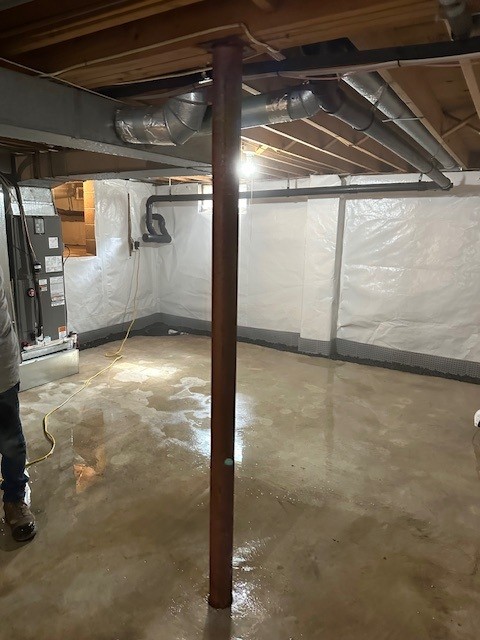
Yes, water can come up through a concrete basement floor, even one with no visible cracks. When the soil under and around your home fills with water, that water presses against the slab and pushes through the weakest points it can find. Those are the joint where the walls meet the floor, hairline cracks, gaps around pipes, and the tiny pores in the concrete itself. The force behind it is called hydrostatic pressure. That’s why basement waterproofing for hydrostatic pressure focuses on relieving and redirecting the water, not just patching the spot where it shows up.
Maybe you have water coming up through your basement floor after a storm. Maybe there’s a damp patch that never quite dries, or puddles that come back no matter how often you mop. You’re not imagining it, and you’re not alone. At Pressman Home Services, our owner-led team sees this in basements across Bucks County, Montgomery County and nearby New Jersey every year, especially in spring. Below, we explain how the pressure builds and where the water gets in. We also cover how to tell seepage from condensation or a plumbing leak, and what actually stops it.
How Hydrostatic Pressure Pushes Water Through Concrete
Hydrostatic pressure is the weight of water pressing on whatever holds it back. When the soil around your foundation is saturated, that water pushes sideways on the walls. When the groundwater level rises above the bottom of the slab, it pushes straight up on the floor. That upward push is what homeowners mean when they say water is coming up through the floor.
Most basement slabs are only about four inches thick, and concrete is full of microscopic pores. Under enough pressure, moisture travels up through them and shows up as damp patches, white residue or standing water. That’s also why a quick patch rarely lasts: plug one opening, and the pressure simply moves the water to the next weak point.
Where Water Comes Up Through the Basement Floor
Water rarely comes up through the middle of a sound slab first. It takes the easiest route, and in most basements we inspect, that route is one of four places.
The Cove Joint
The cove joint is the seam where your basement walls meet the floor. During construction, the footings, walls and floor slab are poured at different times, so this seam isn’t bonded together. It’s the single most common entry point we find. Water rising under the slab, or running down the outside of the wall, collects at the footing and pushes through this gap. The result is often a wet ring along the edge of the floor. We cover this pattern in detail in our article on water coming in the basement where walls meet floor.
Slab Cracks
Almost every basement floor develops some cracks as the concrete shrinks while curing and the house settles. Most are harmless on dry days. Once groundwater rises, though, each crack becomes a ready-made channel, and you’ll see water appear along the crack line, often within hours of heavy rain.
Porous Concrete With No Visible Crack
This is the one that confuses homeowners most. The floor looks perfectly intact, yet a dark, damp area spreads across it after wet weather, and sometimes a thin film of water forms on top. That’s moisture moving straight through the concrete under pressure. As it evaporates, it often leaves a chalky white residue behind. That’s the same mineral deposit people notice as white powder on basement walls, and it’s a reliable sign that water has been passing through.
Pipe and Post Penetrations
Anything that passes through the slab interrupts it. Steel support posts, plumbing lines, old floor drains and utility pipes all have small gaps around them where the concrete never fully bonded. Under pressure, water finds those gaps. If puddles keep forming right around a support post or pipe, that penetration is a likely entry point.
Basement Flooding From Groundwater
Not every wet basement is caused by rain pouring in from the yard. Basement flooding from groundwater happens below the surface, and it behaves differently. Surface water tends to show up during or right after a storm. Groundwater can show up a day or two later, or linger for weeks. Knowing which one you’re dealing with makes a big difference in how the problem gets solved.
Saturated Soil After Heavy Rain
A long, soaking rain or a fast snowmelt fills the soil around your home faster than it can drain. Clay-heavy soils, common across much of our service area, hold that water like a sponge. The pressure against the foundation stays high long after the sky clears. Many homeowners notice water coming up through the floor the morning after a storm rather than during it, because that’s how long the water takes to work its way down and under the slab.
Seasonal High Water Table
Groundwater levels rise and fall over the year. According to Penn State Extension, Pennsylvania groundwater levels tend to peak in March and April as snowmelt and spring rain recharge the ground. They fall through summer and usually reach their lowest point in late September or October, then climb again in late fall. That cycle explains why a basement can be bone dry in August and wet every April. When the water table rises close to or above the bottom of your slab, the floor is under pressure even without a fresh storm.
Older Slabs Without Gravel or a Vapor Barrier
Many older homes in our area have basement floors poured directly onto soil, with no layer of crushed stone underneath and no vapor barrier. Without that gravel layer, there’s nowhere for water under the slab to spread out and drain. Without a vapor barrier, ground moisture moves straight up into the concrete. These floors often stay damp for long stretches, even when there’s no standing water.
Clogged Footing Drains or a Failed Sump
Some homes were built with drain tile around the footings or an older sump system. Over the years, exterior drain tile can fill with silt and roots. An undersized or worn-out sump pump can fall behind or fail completely. When that happens, the water those systems used to carry away stays trapped under the house, and pressure builds again. If your basement used to stay dry and suddenly doesn’t, a drainage system that has stopped working is a common reason. Checking the sump pump is one of the first things we do on these calls.
Wet Spot on the Basement Floor: Seepage, Condensation or Leak
A wet spot on the basement floor doesn’t always mean groundwater is pushing through. Before you decide on a fix, it’s worth ruling out the two other common causes: condensation and plumbing. A few simple checks will usually point you in the right direction.
Start with the plastic sheet test:
- Tape a square of clear plastic, about a foot on each side, tightly to the floor over the damp area, sealing all four edges.
- Leave it in place for 24 hours.
- Lift it and look. Moisture on the underside means water is coming up through the concrete. Moisture on the top means it’s condensation from humid air.
Condensation is common in summer, when warm, muggy air hits cool concrete. It usually shows up as an even film rather than one defined spot. It’s the same thing that causes basement walls sweating, and it’s usually managed with dehumidification rather than drainage.
Timing is your next clue. Water that appears after storms and fades in dry weather points to saturated soil and hydrostatic pressure. Dampness that hangs on for weeks in spring suggests a high water table. Water that shows up in the same spot no matter what the weather is doing deserves a closer look, because the source may be inside the house.
To check for that, turn off every faucet and water-using appliance, then read your water meter. Read it again two hours later without running any water. If the number has moved, water is escaping somewhere in your supply lines. A pipe leaking under the slab can saturate the soil and push water up through the floor in a way that looks a lot like groundwater. That’s a plumbing problem, as is water rising out of a floor drain. Our sister company, Pressman Plumbing, handles leaking pipe repair and can track down the source.
Signs Hydrostatic Pressure Is Affecting Your Basement
Hydrostatic pressure rarely announces itself with a flood on day one. It usually starts with small signs that are easy to dismiss. Watch for these:
- Damp patches or puddles on the floor after rain. Spots that appear after wet weather and dry out in between are a classic sign of rising groundwater.
- Water at the base of the walls. A wet line along the floor edge usually means water is coming through the cove joint.
- White, chalky residue. Mineral deposits on the floor or lower walls show that water has been moving through the concrete, even if it’s dry today.
- Cracks that widen or keep coming back. Pressure and freeze-thaw cycles work on existing cracks, and repeated repairs that fail are a sign the cause hasn’t been addressed.
- A musty smell and high humidity. Constant moisture coming through the slab raises indoor humidity and creates the conditions for mold.
- Damaged flooring. Peeling floor paint, lifting tiles, warped laminate and mildew under rugs often point to moisture coming up from below.
- Walls that bow or lean inward. This is the most serious sign. Strong sideways pressure can push walls out of line, and it needs a professional basement evaluation right away.
Signs Hydrostatic Pressure Is Affecting Your Basement
Hydrostatic pressure rarely announces itself with a flood on day one. It usually starts with small signs that are easy to dismiss. Watch for these:
- Damp patches or puddles on the floor after rain. Spots that appear after wet weather and dry out in between are a classic sign of rising groundwater.
- Water at the base of the walls. A wet line along the floor edge usually means water is coming through the cove joint.
- White, chalky residue. Mineral deposits on the floor or lower walls show that water has been moving through the concrete, even if it’s dry today.
- Cracks that widen or keep coming back. Pressure and freeze-thaw cycles work on existing cracks, and repeated repairs that fail are a sign the cause hasn’t been addressed.
- A musty smell and high humidity. Constant moisture coming through the slab raises indoor humidity and creates the conditions for mold.
- Damaged flooring. Peeling floor paint, lifting tiles, warped laminate and mildew under rugs often point to moisture coming up from below.
- Walls that bow or lean inward. This is the most serious sign. Strong sideways pressure can push walls out of line, and it needs a professional evaluation right away.
How Basement Waterproofing for Hydrostatic Pressure Works
You can’t hold back groundwater pressure forever with concrete alone. The approach that works is to give the water an easier path than your basement floor: collect it before it reaches the living space and carry it away from the house. Basement waterproofing for hydrostatic pressure does that by combining interior drainage, exterior water control and targeted repairs. Each part plays its own role.
- Interior drainage and a sump pump: We install a perforated drain along the basement perimeter at footing level. It catches water at the cove joint and under the slab, then sends it to a sealed sump basin, where a pump pushes it out and away from the foundation. This is the core of our interior waterproofing work.
- Battery backup: A backup keeps the pump running when storms knock out the power.
- Exterior drainage and grading: Clean gutters, extended downspouts and soil that slopes away from the house mean less water against the foundation. Where water pools in the yard, exterior drainage solutions for basement waterproofing can catch it first.
- Floor crack repair: Once drainage relieves the pressure, repairing active cracks finishes the job. Repaired first, cracks just send the water somewhere else.
- Why patches and coatings fail: Hydraulic cement and floor coatings can’t hold back pressure from below. They blister or peel within a season or two.
What to Do Right Now If Water Is Coming Up
If you’ve just found water coming up through your basement floor, a few steps will protect your home and help pinpoint the cause:
- Put safety first. If water is near outlets, extension cords or appliances, stay out of it and shut off power to the basement at the panel if you can do so safely.
- Move belongings up and out. Lift boxes, furniture and electronics off the floor, and pull back rugs and carpet so they don’t trap moisture.
- Document what you see. Take photos and note where the water appears, how much there is, and how long after rain it showed up. This helps any professional diagnose the source quickly.
- Remove the water and dry the space. Use a wet vacuum, then run a dehumidifier and fans to bring humidity down and slow mold growth.
- Check the basics. Make sure your sump pump turns on, and look outside for overflowing gutters or downspouts dumping water next to the house.
- Hold off on new flooring. Don’t cover a damp slab with carpet, laminate or a fresh coat of paint until the cause is fixed, or the moisture will get trapped underneath.
If the water returns after the next rain, it’s time to have the basement evaluated rather than continuing to clean up after it.
Frequently Asked Questions
Can water come up through a concrete basement floor with no cracks?
Yes. Concrete is porous, so when groundwater pressure under the slab is high enough, moisture can move straight through the concrete. You may see dark damp areas, white mineral residue or a thin film of water on an otherwise intact floor. It’s especially common in older slabs poured without gravel or a vapor barrier underneath.
Why is my basement floor wet when it hasn’t rained?
Groundwater lags behind the weather. In Pennsylvania, water tables run highest in spring, so a floor can stay damp for weeks after the last storm. If the dampness stays in one spot through dry spells, run the water meter test to rule out a leaking pipe under the slab.
Will a floor coating stop water coming up through the basement floor?
Not for long when hydrostatic pressure is the cause. Coatings sit on the surface, and pressure from below eventually makes them blister and peel. They can help with minor vapor, but lasting results come from drainage that relieves the pressure.
Is water coming up through the floor a foundation problem?
Not necessarily. In most cases it’s a water management problem, not a sign that the foundation is failing. That said, ongoing moisture can widen cracks over time. Walls that bow, or cracks that keep growing, should be checked promptly.
Is some moisture on a basement floor normal?
Basements are naturally cooler and more humid than the rest of the house, so occasional summer condensation isn’t unusual. Puddles, water marks, white residue or dampness that shows up after every storm are not normal. They mean water is moving through your foundation.
Keeping Your Basement Floor Dry for Good
Water coming up through a basement floor is frustrating, but it’s a solvable problem once you treat the cause instead of the puddle. Hydrostatic pressure builds whenever the ground around and under your home fills with water. In the clay and shale soils of Bucks and Montgomery County, that happens a lot. The fix is to give the water a controlled path out: drainage to relieve the pressure, a reliable pump to remove it, and exterior steps to keep less water near the foundation to begin with.
At Pressman Home Services, Ross Pressman and our team are onsite for every job, from the first inspection to the final cleanup, with no subcontractors. We’ll find where the water is actually coming from, explain what we see in plain terms, and recommend the system that fits your basement, not a one-size-fits-all package. If water keeps showing up on your basement floor, get in touch with our team through our contact page to schedule an inspection.