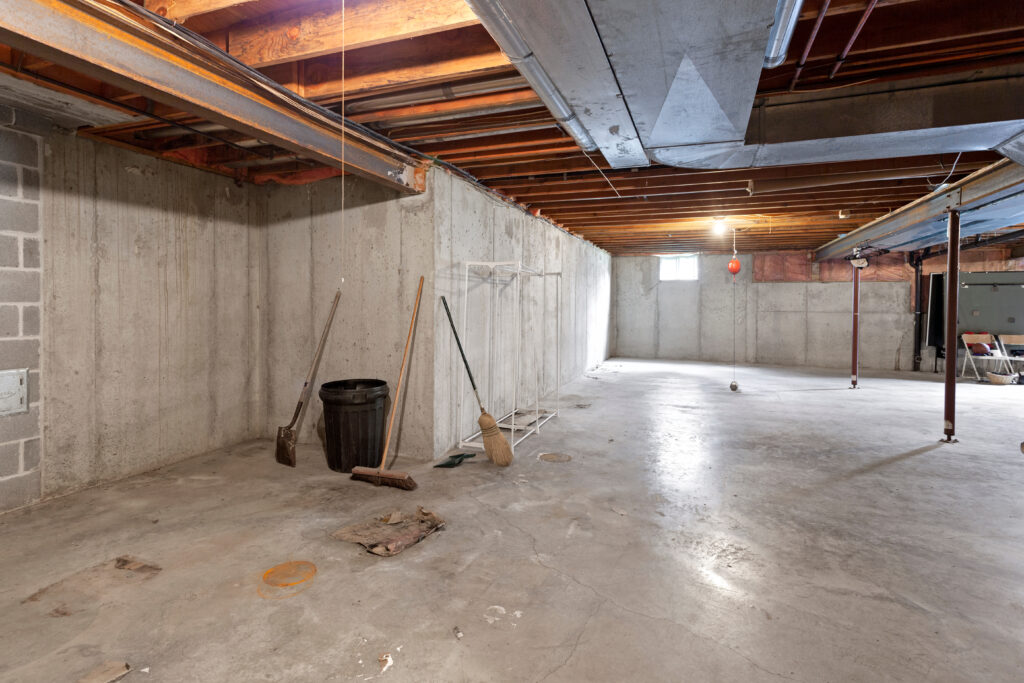
Does ventilation help a damp basement? Sometimes. Moving air only lowers humidity when the air coming in is drier than the air already in your basement, so it helps on cool, dry days and backfires on muggy ones. And if water is coming through the foundation, no amount of airflow will keep up. Below, we compare the main ventilation options and explain when basement waterproofing is the real fix.
Humid Air vs. Water From the Ground
Basement dampness comes from two very different places, and the right fix depends on which one you’re dealing with.
The first is humid air. Basements stay cool because they’re surrounded by earth. When warm, moist air reaches cool walls, floors and pipes, it drops below its dew point and the moisture turns into droplets. That’s the “sweating” you see on block walls in summer. It’s the one moisture source that ventilation and dehumidification can actually address. If you’re seeing beads of water on the face of the wall, it’s worth learning more about basement walls sweating and what drives it.
The second is water from the ground. After heavy rain or snowmelt, saturated soil presses against the foundation. Water works its way in through cracks, the joint where the wall meets the floor, and porous block or stone. That hydrostatic pressure doesn’t care how much air you move. It keeps pushing until the water has somewhere else to go.
Most damp basements our team walks into across Bucks and Montgomery County have a little of both. A simple test helps sort it out: tape a square of plastic sheeting tightly to the wall and leave it for 48 hours. Moisture on the room side of the plastic points to humid air. Moisture trapped behind it means water is moving through the concrete.
When Basement Ventilation Helps and When It Hurts
The rule that settles this comes from the EPA’s mold-prevention guidance: bring in more outside air when it’s cold and dry, and dehumidify when outdoor air is warm and humid. Nearly everything else about basement ventilation follows from that one idea.
Summer Humidity and Open Windows
This is where the old advice to “let the basement breathe” goes wrong. Summer air in southeastern Pennsylvania and New Jersey carries a lot of moisture. When it drifts into a basement that sits in the 60s, it cools and its relative humidity climbs. The extra moisture settles on walls, floors, stored boxes and the underside of carpet.
So should basement windows and vents be open or closed in summer? On hot, humid days, keep them closed. Opening up usually adds more moisture than it removes. Shutting the basement up with no moisture control isn’t the full answer either, because moisture from the house and the ground still builds up. The practical approach is windows closed on muggy days and a dehumidifier doing the heavy lifting.
Cool, Dry Days and Winter
Ventilation earns its keep in spring, fall and on dry winter days. Cold air holds very little moisture, so when it warms up in your basement its relative humidity drops. Swapping stale basement air for that drier air can clear a musty smell and freshen the space quickly.
A good rule of thumb: if it’s cooler and less humid outside than in your basement, ventilation helps. If it’s warmer and stickier outside, it hurts. A hygrometer in the basement, checked against the local forecast, takes the guesswork out of it.
Best Basement Ventilation System: Comparing the Options
There isn’t one best basement ventilation system for every home. The right choice depends on whether the space is finished, how damp it gets, and what’s causing the moisture in the first place. Here’s how the four main options compare.
Option | What it does | Works best for | Main limitation |
Natural ventilation | Lets outside air in through windows and vents | Unfinished basements on cool, dry days | Brings in moisture during humid weather |
Exhaust fan or exhaust-only system | Pushes basement air outside and pulls replacement air from upstairs | Clearing odors in air-conditioned homes | Doesn’t remove moisture itself; can pull in soil gases and backdraft gas appliances |
Basement dehumidifier | Pulls water out of the air and drains it away | Almost any basement with humidity above 50–60% | Treats humid air only, not water coming through the foundation |
ERV or HRV | Exchanges stale air for fresh air while recovering energy | Finished basements used as living space | Supplies fresh air, but usually still needs a dehumidifier in our climate |
Natural Ventilation
Windows, vents and open doors are the simplest form of basement ventilation, and they cost nothing to use. Many older basements in our area only have a couple of small hopper windows, though, so the airflow they provide is limited. The bigger issue is control. Natural ventilation works on cool, dry days and works against you for much of the summer.
Exhaust Fans and Exhaust-Only Systems
A through-wall or inline fan pushes basement air outdoors, and replacement air gets pulled down from upstairs or in through gaps. Branded “basement ventilation systems” sold as low-energy dehumidifiers work the same way. When the upstairs is air-conditioned and dry, they can help with odors and mild dampness.
They don’t remove moisture on their own, though, and they come with trade-offs. Pulling air out lowers the pressure in the basement. That draws soil gases in through foundation cracks and makes your heating and cooling system work harder. Exhaust-only ventilation can also cause backdrafting in gas water heaters, furnaces and fireplaces. If you have combustion appliances in the basement, talk to an HVAC professional before adding one.
Basement Dehumidifiers
A dehumidifier is the only option on this list that actually removes water from the air, no matter what the weather is doing outside. For a basement, look for three things:
- A unit rated for the size of the space
- A built-in humidistat
- A continuous drain line, ideally routed to your sump pit, so you’re not emptying a bucket twice a day
Keep in mind what a dehumidifier can’t do. It controls humid air; it doesn’t stop water coming through the walls or floor. If yours fills up within hours or never gets the humidity down, it’s telling you water is getting in from outside.
ERVs and HRVs
Energy recovery ventilators (ERVs) and heat recovery ventilators (HRVs) are balanced systems. They exhaust stale air and bring in fresh air at the same rate, recovering energy between the two streams. For basements, ERVs are generally the better pick in most U.S. climates because they cope better with summer humidity. They’re a good fit for finished basements used as bedrooms, offices or family rooms.
An ERV is a fresh-air system, not a dehumidifier, so most finished basements in our region still need dehumidification alongside it. These are HVAC appliances, sized and installed by an HVAC contractor.
For most basements we see, the best setup has three parts:
- A properly sized dehumidifier for humidity
- Ventilation used on the right days, or an ERV for finished living space
- Waterproofing that keeps ground water out
Choosing a Setup for Your Basement
Start with how you use the space. An unfinished basement used for storage, laundry and mechanicals usually does well with a dehumidifier and some smart, occasional ventilation. A finished basement that people live in needs steady fresh air too, which is where balanced ventilation earns its place. Exhaust-only fans are the weakest fit for finished space.
Next, think about what’s already down there. Gas furnaces and water heaters need enough combustion air, and anything that depressurizes the basement can interfere with how they vent. That’s a conversation for your HVAC contractor before any fan goes in.
Radon matters here too, especially in Pennsylvania. According to the Pennsylvania Department of Environmental Protection, roughly 40 percent of homes in the state have radon above the EPA action level of 4.0 pCi/L, and the gas can get in through cracks in basements and foundations. Because exhaust-only fans lower basement pressure, it’s smart to test for radon before adding one. If your levels come back high, a PA-certified radon mitigation contractor is the right call.
Finally, plan where the water goes. A dehumidifier pulls gallons of water out of the air on humid days, so a drain line to your sump pit or a condensate pump keeps it running without babysitting.
Ideal Basement Humidity Level
EPA guidance is to keep indoor humidity under 60 percent, and ideally between 30 and 50 percent. Above that range, mold and mildew have an easier time getting started on drywall, wood framing and anything stored in cardboard.
The easiest way to know where you stand is a digital hygrometer. Check it at different times of day and after a few rainy days. If your basement sits above 60 percent for much of the summer, you need dehumidification, not more airflow. If it stays high even with a dehumidifier running, look for a water source rather than buying a bigger machine.
A persistent smell is another clue. The air may read fine on the hygrometer while the space still smells off. In that case, it helps to understand why a basement smells damp, because odor often points to moisture trapped in materials.
When Ventilation Won’t Fix a Damp Basement
Ventilation and dehumidifiers manage the air. They can’t manage water that’s pushing in through the foundation. These signs point to a water problem rather than a humidity problem:
- Water along the joint where the wall meets the floor after rain
- White, chalky deposits (efflorescence) on block or poured walls
- Damp patches that grow or darken after storms
- Cracks that leak or stay wet
- A dehumidifier that fills up within hours
- Peeling paint, or mold along the bottom of drywall and paneling
If you’re seeing these, the lasting fix is basement waterproofing. That means giving water a path away from your home instead of trying to hold it back at the wall surface. In many basements, interior waterproofing is the answer. A drainage system along the perimeter collects water before it reaches your floor and carries it to a sump pump that sends it outside. Outside the house, grading and downspout extensions keep roof and surface water from soaking the soil next to the foundation.
Once the water is under control, ventilation and dehumidification finally work the way they’re supposed to. If moisture has already led to growth on framing or drywall, pair professional mold removal with fixing the source so it doesn’t come back.
Does Ventilation Help a Damp Basement in Bucks, Montgomery and NJ?
Local conditions make basement moisture a year-round concern here. Much of Bucks County sits on clay-heavy soil that holds water against foundations long after a storm passes. Many older homes across the region were built on fieldstone or block foundations with no drainage system at all. Plenty of post-war neighborhoods also have block walls that let moisture wick through.
Then there’s the weather. Our summers are hot and humid, which is exactly when open windows do the most damage. Heavy rain events like the remnants of Hurricane Ida in 2021 showed how fast saturated ground can push water into basements across the area. New Jersey homes along the Delaware River and in low-lying parts of Mercer County deal with many of the same issues.
That’s why we rarely recommend ventilation as a stand-alone fix in this area. Whether you’re in a borough rowhome or a split-level outside town, we look at the soil, the foundation and the drainage before talking about airflow.
Frequently Asked Questions
Should basement windows be open or closed in summer?
Closed on hot, humid days. Warm summer air cools down in the basement, its relative humidity rises, and the moisture ends up on your walls and belongings. Open them on cooler, drier days if you want fresh air, and let a dehumidifier handle humidity the rest of the time.
Do exhaust-only basement ventilation systems work?
They can reduce odors and mild dampness when the air upstairs is drier than the basement, usually in a home with central air. They don’t remove moisture on their own, they add load to your HVAC system, and they can pull soil gases into the basement. For true humidity problems, a dehumidifier is the more reliable tool.
Is a dehumidifier better than a fan for a basement?
For moisture, yes. A fan only moves air around or swaps it with outside air, while a dehumidifier physically removes water from it. A small fan can still help by moving air from stagnant corners toward the dehumidifier so the whole space dries evenly.
Should a basement dehumidifier run all the time?
Set it to a humidity target, around 45 to 50 percent, and let the humidistat cycle it on and off. In summer it may run most of the day, and in winter it may barely run at all. If it runs constantly and never reaches the target, have the basement checked for water intrusion.
Keep Your Basement Dry for Good
Ventilation has a role in a healthy basement, but it’s a supporting one. Use outside air when it’s cool and dry, rely on a dehumidifier when it isn’t, and choose balanced ventilation for finished living space. When water is coming through the foundation, though, no fan or machine will keep up. That’s a job for basement waterproofing done right the first time.
At Pressman Home Services, our owners are onsite from the first inspection to the final walkthrough, and we never hand your basement off to subcontractors. We’ll find where the moisture is coming from and tell you honestly whether you need better air management or a waterproofing system. If your basement feels damp, smells musty or never seems to dry out, get in touch with our team through our contact page to schedule an inspection.